@pandatao.me Sichuan, Chengdu


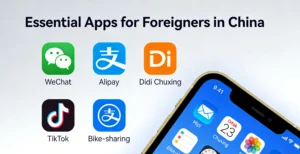
Quick Summary: What You’ll Learn
The 3 non-negotiable apps that replace your wallet, map, and phone service
How to pay anywhere with a foreign credit card (and avoid getting stranded)
Which map app actually works when Google Maps is blocked
The ride-hailing trick that saves 15 minutes every time
Food delivery & discovery—even if you don’t read Chinese
Setup checklist to avoid airport meltdowns
Shanghai is often the first stop for travelers entering China, and it’s a city that rewards preparation. While this guide focuses on the essential apps you’ll need, this first-time visitor’s guide to Shanghai takes the next step—helping you plan your days, choose accommodations, and discover the city beyond the QR codes.
- https://pandatao.me/shanghai-travel-guide/
Introduction: Why Your iPhone Becomes Your Passport in China
You walk into a noodle shop in Shanghai. You pull out cash. The cashier smiles patiently and points to a small QR code taped to the counter.
This is your first lesson.
China isn’t just using apps—it runs on them. Your ability to eat, travel, communicate, and even find a public restroom depends entirely on how prepared your phone is. This isn’t convenience tech. This is the infrastructure of daily life.
If you’re arriving with Google Maps, Uber, and a wallet full of cash, you’re effectively bringing a typewriter to a coding bootcamp.
Let’s fix that.
Section 1: The Digital Passport – WeChat & Alipay

These two apps aren’t optional. They’re your identity, your bank, and your social graph.
WeChat (微信) – Your Swiss Army Knife
Think of WeChat as WhatsApp, Facebook, PayPal, and your local government portal—all inside one app.
What it does: Messaging, payments, booking services, accessing government portals, group chats for your apartment building
The critical feature: QR code contacts. When someone scans your code, you’re not “adding a friend”—you’re entering a network where everything from dinner bills to building security happens.
Foreigner tip: Complete real-name verification with your passport before you need it. Do this on hotel Wi-Fi, not while standing at an airport taxi stand with spotty signal.
Alipay (支付宝) – Your Financial Engine
Alipay started as China’s answer to PayPal and evolved into a full-service transaction platform.
What it does: Payments, metro entry, bill splitting, train tickets, utility payments
WeChat vs. Alipay: Both handle payments. Alipay is more purpose-built for transactions. WeChat is where your social life lives. Most locals use both.
Foreign credit cards: Yes, both now accept Visa and Mastercard from international users. However, some smaller vendors may only accept Chinese bank cards.
Bottom line: WeChat is your social handshake. Alipay is your financial handshake. Together, they’re proof you exist in China.
Section 2: Getting Around – Maps & Transportation
Gaode Maps (高德地图) – Your Only Real Map Option
Google Maps is blocked. Apple Maps works intermittently. Gaode Maps (also called AMap) is what locals use.
Why it’s better: Real-time bus locations, subway crowding alerts, voice navigation, lane-level driving directions
The challenge: Interface is almost entirely in Chinese
Workaround: Learn the characters for your hotel, major landmarks, and “subway station” (地铁站). You can search in pinyin, but accuracy is unreliable.
Pro move: Drop pins for key locations before you leave Wi-Fi. Screenshot directions. The app works offline for basic navigation if you pre-load.
Didi (滴滴) – Uber’s Replacement
Didi is China’s ride-hailing monopoly. It’s safe, reliable, and available via its own app or as a mini-program inside WeChat/Alipay.
Critical distinction most travelers miss:
| App Name | Where It Works |
|---|---|
| DiDi Rider | Australia, Japan, Latin America—NOT reliably in mainland China |
| DiDi China: Ride Hailing | Mainland China version—this is what you need |
Download the wrong one, and you’ll be standing on a Beijing sidewalk wondering why no car is coming.
The phone call problem: Drivers will call you. They speak Mandarin. Have your hotel or a local friend pre-write a message like “I’m at the south gate in a blue jacket” to paste into the in-app chat.
English interface: Yes, Didi has one. Use the built-in translation for messages.
12306 – The Train Ticket Backbone
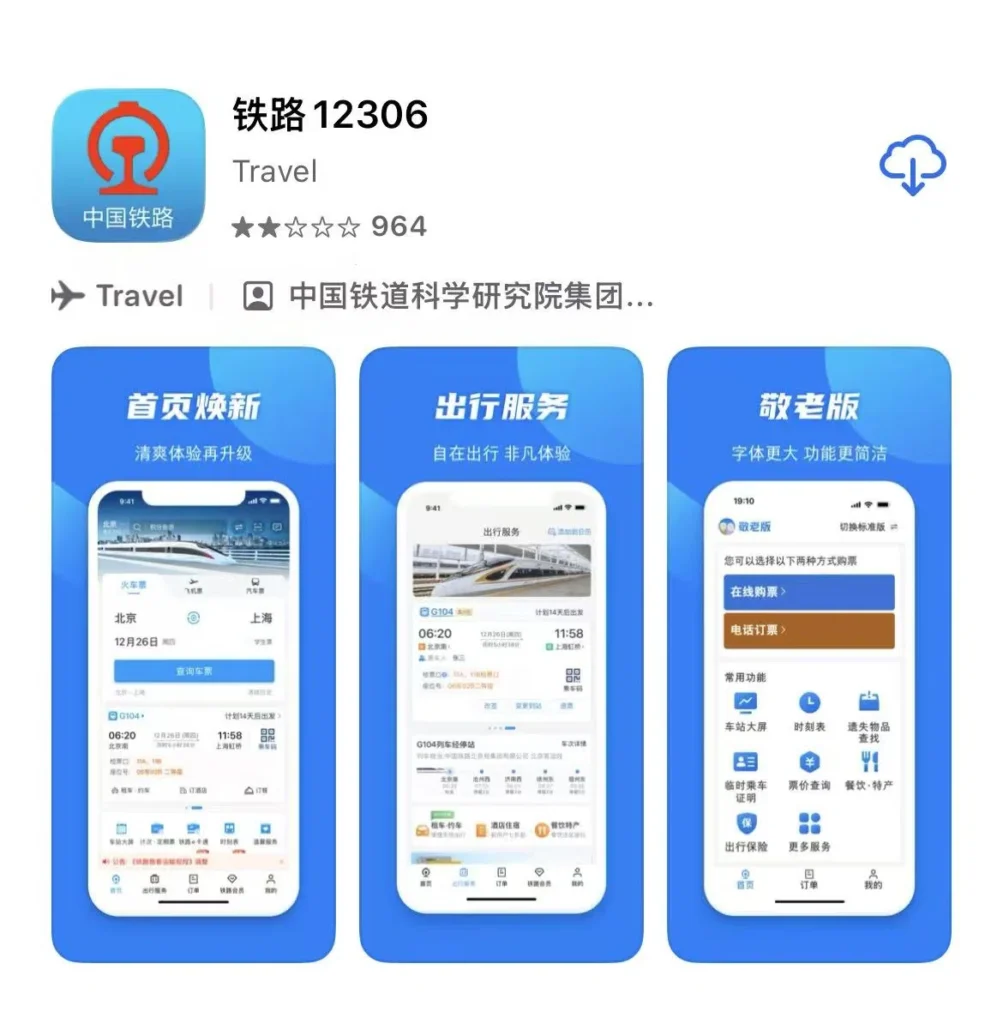
When you travel between cities—Beijing to Xi’an, Shanghai to Hangzhou—every high-speed train ticket routes through 12306, China’s official railway platform.
Use it directly: The app has an English version, though it’s clunky
Use it indirectly: Trip.com and other third-party services book through 12306
Why it matters: You can’t skip it. Every train ticket in China traces back to this system.
Navigation hierarchy: Gaode shows you how the city moves. Didi carries you through it. 12306 connects the cities.
Section 3: Food – Ordering & Discovering
Delivery Titans: Meituan & Ele.me
| App | Best For | Interface |
|---|---|---|
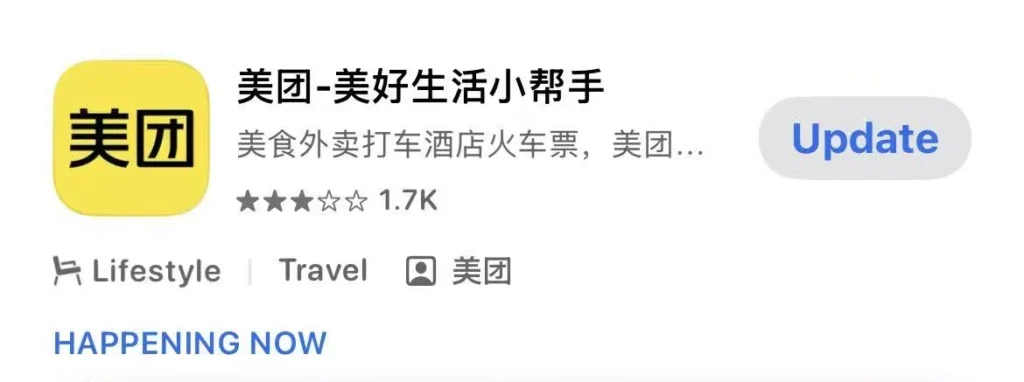
| Meituan (美团) | “Everything app”—food, hotels, movies, bike-sharing, restaurant reviews | Chinese only |
| Ele.me (饿了么) | Pure food delivery, often different restaurant promos | Chinese only |
| Sherpas | English menus, Western/upscale local spots | English (premium pricing) |
If you don’t read Chinese: Use a translation app like Pleco or Google Translate (via VPN) to navigate Meituan. Screenshot menus. The photos are usually clear enough to order visually.
Dazhong Dianping (大众点评) – The Real Restaurant Finder
This is China’s Yelp—but better.
What makes it powerful: Locals post extensive photos. You can scout ambiance and dishes before walking in.
The hidden filter: “Per Capita Spend” (人均消费). A ¥50 place is a local canteen. A ¥500 place is for business banquets. This single filter tells you more than any star rating.
For discovery: Search your city name in pinyin on Xiaohongshu (see Section 4) to find trendy spots off the tourist trail.
Food app strategy: Meituan delivers the feast. Dianping teaches you where to find it.
Section 4: Lifestyle & Shopping – Beyond Survival
Taobao (淘宝) – The Infinite Bazaar
Alibaba’s massive marketplace. You can find anything—silk scarves, bespoke tea sets, phone cases, custom furniture. The algorithm is aggressive but effective.
JD.com (京东) – The Reliable Alternative
Better for electronics, faster delivery, more structured experience. Think Amazon Prime vs. eBay.
Xiaohongshu (小红书) – “Little Red Book”
This is where you find what’s current. A hybrid of Instagram and Pinterest, dominated by millions of users (mostly young women) posting photo-heavy reviews of:
Café aesthetics in Shanghai
Skincare routines
Travel itineraries
Hidden shopping finds
For travelers: Search your destination city in pinyin here. You’ll discover spots that haven’t made it to English-language blogs.

Section 5: Setup Checklist – Do This Before You Land
Before Departure
Download WeChat and Alipay
Complete real-name verification with passport photo
Link foreign credit card (Visa/Mastercard)
Download Gaode Maps (learn key characters)
Install a reliable VPN that works in China (test before departure)
Download DiDi China: Ride Hailing (not DiDi Rider)
Install translation app (Pleco is excellent for Chinese)
Upon Arrival
Buy a local SIM card at the airport (China Mobile, China Unicom, or China Telecom)
Register your Chinese phone number in WeChat and Alipay
Enable notifications for all essential apps—this is how you receive time-sensitive updates from drivers and delivery riders
Critical Warning
What happens if your phone dies? You are functionally stranded. No payments. No ride-hailing. No maps.
Solution: Carry a power bank at all times. This isn’t optional—it’s as essential as your passport.
Section 6: What to Skip (If Your Trip Is Short)
| App | Skip If… |
|---|---|
| Taobao | You’re not shopping for physical goods to ship domestically |
| JD.com | Same as above |
| Xiaohongshu | You’re not seeking hyper-local trendy spots |
| Ele.me | You already use Meituan (coverage overlaps) |
| 12306 direct | You use Trip.com for train bookings |
Focus your setup on: WeChat, Alipay, Gaode Maps, Didi, and a VPN. These five get you 90% functional.
Section 7: The Cultural Layer – What the Apps Reveal
This ecosystem isn’t just about efficiency. It reflects a cultural value: radical convenience.
Cash friction? Eliminated.
Uncertainty about a restaurant? Reviewed into oblivion.
Street-hailing ambiguity? Gone.
Everything is engineered to be seamless. For visitors, this creates a strange duality: you can scan to pay, but you might not understand the social credit implications behind a Meituan score. You can order delivery, but you’ll miss the theater of a street-food stall.
The apps grant you access. The culture lies in watching how effortlessly they fade into the background for everyone else—becoming not technology, but simply the way things are.
FAQ: Quick Answers for Travelers
Can I use Google Maps in China?
No. Google services (Maps, Gmail, Search) are blocked. Use Gaode Maps and a VPN.
Do I need a Chinese phone number?
Yes, for full functionality. Most apps require local number verification. Buy a tourist SIM at the airport.
Can I link my foreign credit card to Alipay or WeChat?
Yes. Both accept Visa and Mastercard from international users. Some small vendors may still require Chinese bank cards.
Is Didi safe for foreigners?
Yes. The app provides driver details, real-time tracking, and an emergency button. Use the English interface and built-in translation.
Which food delivery app has English?
Sherpas offers English menus but at higher prices. For Meituan/Ele.me, use a translation app.
What if my phone battery dies?
You are effectively stranded. Carry a power bank. This is the single biggest point of failure for travelers in China.
Tags

Tao
Chris Lee (Tao) is the founder of PandaTao, a journal exploring China through its cities, tea, and traditional crafts. He shares stories of everyday culture — from quiet teahouses and local markets to the small rituals that shape daily life in China.
📬 Stay updated: Get insider tips, guides, and stories by email at pandatao.me@gmail.com