@pandatao.me Sichuan, Chengdu

Before diving into the step-by-step Gaiwan brewing process, check out our Chengdu Tea Culture Guide to understand the rich traditions and local habits that make teahouses a central part of daily life here.
What Is a Gaiwan? The Three Pieces and Their Symbolism
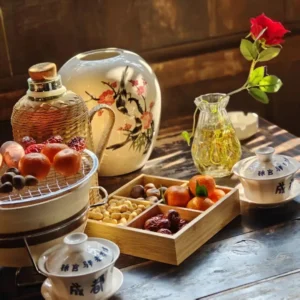
The iconic Chengdu teahouse experience centers on the “three-piece head” or “three-talent bowl”:
Bowl: Represents humanity. Holds the tea and enables the ritual.
Lid: Represents heaven. Keeps tea warm, cools it, and filters leaves while sipping.
Saucer (tea boat): Represents earth. Protects your hands and serves as a base.
Together, they reflect a harmony between man and nature, a principle embedded in Chengdu tea culture.
Step-by-Step: How to Drink Tea with a Gaiwan
Step 1: Receive and Place Your Tea
After ordering, the server delivers your set with San Hua jasmine tea pre-measured in the bowl. Hot water may be poured from a long-spouted copper kettle—a skillful, traditional display kept alive in teahouses like Beimen Bridge and He Ming Teahouse.
Step 2: Let It Steep and Observe
Allow the tea to steep briefly, about 1 minute. Watch the leaves unfurl and inhale the rising jasmine aroma. This pause is your first step into Chengdu time.
Step 3: Hold the Bowl Correctly
Place your thumb and middle finger on the rim of the saucer, and use your index finger to gently secure the lid. This three-point hold is stable, elegant, and shows respect for the ritual.
Step 4: Sip Using the Lid
Tilt the lid slightly to create a gap for tea to flow through while holding back leaves. Sip slowly, letting the aroma and warmth reach your senses. The lid also cools the tea to the perfect temperature.
Step 5: Skim and Repeat
Gently push floating leaves aside with the lid between sips. Each bowl can last hours with multiple hot water refills.
Understanding San Hua Jasmine Tea
San Hua Cha (“Three Flowers Tea”) is the most common tea in Chengdu teahouses. Contrary to its name, it is a grade designation, not a blend.
Developed after 1951 by the state-owned Chengdu Tea Factory.
Scented with jasmine three times for maximum aroma fusion.
Affordable, fragrant, and durable, ideal for multiple infusions.
Locals describe drinking it as “enjoying three flowers”, a phrase reflecting Chengdu’s daily life and tea philosophy.
The Ritual Beyond the Bowl
Watch the tea masters skillfully pour boiling water from long-spouted copper kettles. Observe social interactions: elders chatting, playing mahjong, reading, or just resting. Some teahouses, like Guanyinge Old Teahouse, offer services like ear cleaning or snacks, while others, such as Jin Qin Old Teahouse, welcome delivery workers with free tea.
Tea here is not just a beverage—it’s community, performance, and ritual.
Teahouse Etiquette: Do’s and Don’ts
Do:
Embrace the slow pace; stay at least 1–2 hours.
Manage refills yourself; thermoses are often on the table.
Try local snacks: Zhong Shui Jiao dumplings at He Ming, vegetarian bean jelly at Da Ci.
Observe the crowd: mornings favor elders, afternoons a mix of locals and tourists.
Don’t:
Expect silence; ambient noise is part of the experience.
Be surprised by worn bamboo furniture—it’s authentic.
Worry about smoking in semi-enclosed spaces.
Look for Wi-Fi; teahouses are for rest and socializing, not work.
Using a Gaiwan is just one part of the experience—our Chengdu Tea Culture Guide explores how these rituals fit into the broader teahouse culture and local lifestyle.
From Traditional Gaiwan to Modern Tea Spaces
Modern Chengdu tea culture innovates without losing tradition:
Natural Record Leafroom: Daytime teahouse, nighttime tea-infused cocktail bar.
He Ming Teahouse branch in commercial complexes: Add unique toppings like fish mint or chili flakes.
The ritual of sitting, sharing, and savoring tea remains the core, even as techniques evolve.
Practical Tips for Visitors
Timing: Early tea (before 9:30 AM) offers local feel and low prices (3–5 RMB).
Payment: Cash is preferred in smaller, older teahouses.
Season: Sunny days fill outdoor seats; arrive early.
Food pairing: Many teahouses connect to restaurants—enjoy tea first, then Sichuan food.
Where to Go: Recommended Teahouses
| Teahouse | Highlights | Location / Notes |
|---|---|---|
| He Ming Teahouse | Classic gaiwan service | People’s Park, Subway Line 2 |
| Guanyinge Old Teahouse | Historic, photogenic | Peng Town, taxi recommended |
| Jin Qin Old Teahouse | Lively local community | Near Fuqin, Subway accessible |
| Da Ci Tea House | Temple setting, modern shops | Daci Temple, Taikoo Li area |
| 678 Tea Shop | Outdoor, open-air experience | Mengzhuiwan |
Want to see how teahouses fit into the bigger picture? Our full Chengdu Tea Culture Guide dives into local tea traditions, etiquette, and the social role of tea in Chengdu.
Enjoyed this piece?
Join our newsletter for occasional notes on cities, tea, and craft in China.
Tags

Tao
Chris Lee (Tao) is the founder of PandaTao, a journal exploring China through its cities, tea, and traditional crafts. He shares stories of everyday culture — from quiet teahouses and local markets to the small rituals that shape daily life in China.
📬 Stay updated: Get insider tips, guides, and stories by email at pandatao.me@gmail.com