
Xi'an Terracotta Warriors — Quick Answer
- They are a life-sized clay army built to guard the tomb of China’s First Emperor, Qin Shi Huang.
- Located about 1.5 km east of the emperor’s burial mound in Lintong District, Xi’an.
- Discovered in 1974 by farmers digging a well. Over 8,000 soldiers, chariots, and horses are estimated to exist.
- Divided into three main pits: Pit 1 (largest infantry force), Pit 2 (mixed forces), and Pit 3 (command center).
- A UNESCO World Heritage Site, often called the “Eighth Wonder of the World.”
- Visiting with a knowledgeable guide is essential to understand the context.
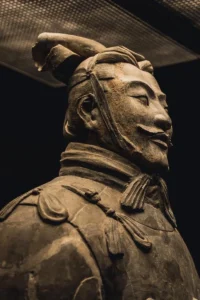
The Terracotta Army (兵马俑, Bīngmǎ yǒng) is a collection of thousands of life-sized, hand-sculpted clay figures representing the armies of Qin Shi Huang, the first emperor of a unified China. They were buried with him around 210–209 BCE to protect him in the afterlife.
Why the Terracotta Warriors Were Created
The creation of the Terracotta Army was an act of staggering ambition rooted in ancient Chinese beliefs. Emperor Qin Shi Huang, obsessed with immortality and power, operated on the principle of “事死如事生” (treat death as life). He intended to rule a complete empire in the afterlife, requiring a military, administration, and all worldly pleasures. This replaced the older, brutal practice of live human sacrifice, making the clay army a paradoxically “humane” advancement for its time.
The figures are a direct reflection of the real Qin army. The average warrior stands at 1.8 meters tall, taller than the average man of the era, designed to project imposing might. The sheer logistical nightmare of its creation—involving thousands of artisans, standardized assembly-line production (feet, legs, torsos, heads made separately), and vast kilns—speaks to the total control of the Qin state. Local Reality Check: Many visitors expect a single, vast hall. In reality, the site is a sprawling archaeological park. The famous, crowded Pit 1 is just one part; the unexcavated burial mound of the emperor himself, a quiet green hill, is the true centerpiece, visible in the distance and far more mysterious.
A Practical Guide to Visiting the Warriors
This is where most guidebooks fail. Your experience is 90% dictated by how and when you visit. The museum is in Lintong District, about a 40-kilometer drive from central Xi’an. You can take a tourist bus (游5) from the Xi’an Railway Station square, hire a car, or join a tour. Booking a knowledgeable, licensed guide in advance is non-negotiable. The on-site audio guides are decent, but a human guide can navigate crowds and answer nuanced questions.
The best time to enter is right at opening (8:30 AM) or after 3 PM. Midday sees a tidal wave of tour groups. A good guide will take you against the flow, perhaps starting in the smaller, more detailed Pit 2. Wear comfortable shoes; you’ll walk on hard concrete for hours. Observed Detail: Watch the museum restorers at work in Pit 1. Behind glass, they sit under bright lamps, meticulously fitting together shards of a warrior’s leg like a 3D jigsaw puzzle. One taps a fragment gently with a small tool, the tink sound swallowed by the hall’s murmur. It’s a slow, silent dance of reconstruction that has lasted decades.
The Warriors Up Close: Artistry and Secrets
Moving past the initial awe, the true miracle is in the details. This is where the “thousand armies, ten thousand faces” (千军万马, qiān jūn wàn mǎ) saying comes alive. Hairstyles are intricately knotted according to rank and origin. Armor plates are rendered with functional realism; on kneeling figures, the plates below the waist overlap upward to allow movement, while those above overlap downward. The soles of their shoes have detailed tread patterns.
The most famous individual is the Kneeling Archer. He is the only figure found completely intact, spared crushing because he was sheltered in a corner. From the side, his silhouette is said to mirror the map of Shaanxi Province. Then there’s the legendary Green-Faced Warrior, a single figure with a face painted in malachite green, an anomaly that theories—from a shaman to a simple artisan’s error—have failed to fully explain. Local Reality Check: Forget the vibrant, colorful warriors you see in artist reconstructions. Upon excavation, the pigments (made from minerals and organic binders) flaked off within minutes of exposure to air. What we see today is the fired clay body. The vivid colors are gone, which is why much of the site remains deliberately unexcavated.
Key Facts and Figures at a Glance
- Location: Lintong District, Xi’an, Shaanxi Province.
- Discovery Date: March 1974, by local farmers drilling a well.
- Construction Period: Approximately 39 years, starting around 246 BCE.
- Estimated Figures: Over 8,000 soldiers, 130 chariots, and 670 horses.
- Pit 1: The largest, containing over 6,000 infantry and chariots in battle formation.
- Pit 2: Mixed forces (cavalry, chariots, archers, infantry), considered the most tactically complex.
- Pit 3: The smallest, believed to be the high command post.
- Height Range: Warriors vary from 1.72 m to 1.96 m tall.
- UNESCO Listing: Inscribed as a World Heritage Site in 1987.
Common Mistakes When Visiting the Terracotta Warriors
- Skipping a guide. Without context, you’re looking at a field of broken statues. A guide deciphers the ranks, tactics, and history, transforming the visit.
- Only visiting Pit 1. While the most impressive, Pits 2 and 3 hold the most fascinating individual figures and tactical displays. The on-site museum with the bronze chariots is also often overlooked.
- Expecting to see the Emperor’s tomb. The warriors are just the outer guard. The tomb mound itself is separate and has not been excavated. You can visit the park, but the interior remains sealed, likely for centuries more.
- Rushing the visit. Many tours allot only 2-3 hours. To truly absorb it, plan for a half-day. The scale and detail require slow observation.
- Ignoring the discovery story. The humble farmer’s well that started it all is marked inside Pit 1. Overlooking this spot misses the incredible serendipity of the find.
High-Retention Insight: The Terracotta Warriors are not a celebration of empire, but a monument to its cost—built by conscripted laborers under a brutal regime, meant to serve one man’s ego for eternity, yet ultimately abandoned, ransacked, and forgotten until a chance dig for water.
The Unanswered Questions
Standing before the ranks, your mind turns to what remains hidden. The majority of the warriors are still buried. The emperor’s tomb, described by ancient historians as containing rivers of mercury and a starry ceiling, lies untouched. The archaeological consensus is clear: we lack the technology to excavate it without causing irreparable damage. The real wonder may not be what we’ve found, but what we’ve wisely chosen to leave for the future.
Frequently Asked Questions
How much time do I need at the Terracotta Warriors?
Plan for a minimum of three to four hours to see the three main pits and the museum of bronze chariots at a reasonable pace. A full half-day is ideal.
What is the best way to get to the Terracotta Warriors from Xi’an city center?
The most reliable public transport is the tourist bus line 游5 (306) from the square in front of Xi’an Railway Station. For more flexibility and comfort, book a private car or join an organized tour that includes transportation and a guide.
Are the Terracotta Warriors the actual tomb of the emperor?
No. The warriors are a protective garrison placed in pits east of the main burial mound. The emperor’s tomb is a separate, large mound about 1.5 kilometers to the west, which has not been excavated.
Why are the Terracotta Warriors not colorful?
They were originally painted in vivid pigments. However, the lacquer base under the paint dried and curled within seconds of exposure to the dry air after two millennia in a damp environment, taking the color layer with it. This is a primary reason for halting further excavation.
Is it worth going inside the Qin Shi Huang Mausoleum park?
The burial mound itself is a large, tree-covered hill. You can walk around the peaceful park for atmosphere and scale, but there is no interior to enter. The main historical focus and artifacts are at the Warriors museum complex.
Can I take photos of the Terracotta Warriors?
Yes, photography for personal use is allowed (flash is prohibited). However, getting a clear, crowd-free shot, especially in Pit 1, is challenging. Your best bet for detail shots is in Pits 2 and 3.
The Terracotta Warriors force a confrontation with time—not as a linear history, but as a layered present. You stand with 21st-century crowds, looking at 1970s archaeology, studying 3rd-century BCE art, all contemplating one man’s 2nd-millennium BCE fear of death. The true craft on display isn’t just the sculpting of clay, but the human desire to make something, anything, last.
After experiencing the traditional and classical beauty of Xi’an, China, you might wonder which city in China is more modern and fashionable? That’s right, it’s Shanghai! If you’re interested in Shanghai, our “Shanghai Travel Guide (First-Time Visitor Edition)” will help you see a completely different China.