
You don’t “browse a menu” in a Chengdu teahouse.
If you hesitate, the server will just stand there waiting — and you’ll feel instantly out of place.
Here’s the simple system locals use:
👉 Say the tea name + number of bowls, and you’re done.
Everything else — refills, seating, even how long you stay — follows automatically.
Quick Answer
- Best first tea → Jasmine (Sanhua)
- What to say → “Yī wǎn mòlìhuā chá” (one bowl jasmine tea)
- Price → ¥20–40 per bowl
- Refills → unlimited hot water
- Stay time → no limit (you’re paying for the seat)
How to Order Tea (Step-by-Step)
Ordering tea is a three-second transaction — have your phrase ready before the server arrives. The process is not about browsing a menu; it’s about stating your choice clearly.
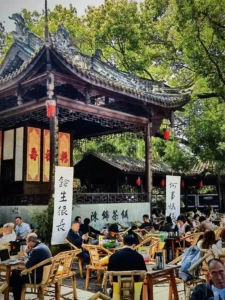
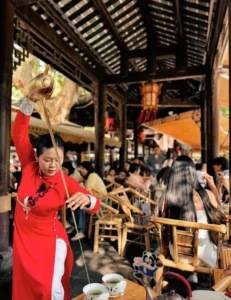
- Find Your Seat: Walk in, scan for empty bamboo chairs at a table. If a tea bowl, lid, or hat is on the table, the seat is taken. An empty table is fair game.
- Wait for Service: A server (堂倌 tángguān) will approach. They rarely initiate conversation.
- State Your Order: Use the formula: Number + Bowl + Tea Name.
* “Liǎng wǎn zhú yè qīng.” (Two bowls of Zhuyeqing.)
* “Yī wǎn bì tán piāo xuě.” (One bowl of Bitan Piaoxue.)
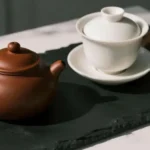
- Receive Your Set: You’ll get a 盖碗茶 gàiwǎn chá (lidded bowl), a tea bag, and a thermos of boiling water. Place the tea in the bowl, the server will pour the first water.
- Manage Your Session: The thermos is for unlimited refills. To signal for a refill, place the lid of your bowl askew on the saucer. To leave temporarily (bathroom, walk), place the lid on top of the bowl with a small item (like a peanut) on it.
HONEST TAKE: Don’t overthink the tea quality at a mass-market teahouse like Heming. You’re paying for the seat and the atmosphere. The tea is fine, not exquisite.
What Tea Should You Drink? The 4 Local Standards
The most common teas are all Sichuan-grown, floral or green, and designed for all-day drinking — not for delicate tasting. You’ll see them on every menu.
- 茉莉花茶 Mòlìhuā Chá (Jasmine Tea) / “三花 Sānhuā”: This is the classic. A green tea scented with jasmine flowers. “Sānhuā” refers to the third-grade, most common and affordable version. It’s fragrant, slightly sweet, and hard to over-steep. 👉 Best for: Your first bowl. It’s the default choice for a reason.
- 竹叶青 Zhúyèqīng: A famous, higher-grade green tea from Mount Emei. The leaves are flat and straight, resembling bamboo leaves. The taste is clean, slightly chestnut-like, with less floral punch than jasmine. 👉 Best for: When you want a purer, less perfumed tea experience.
- 碧潭飘雪 Bìtán Piāoxuě: A visually beautiful jasmine tea where white flower petals are mixed with the leaves. When steeped, they “float like snow.” The taste is a lighter, more elegant jasmine. 👉 Best for: A slightly more premium, photogenic choice.
- 素毛峰 Sù Máofēng: A simple, un-scented green tea (maofeng style). It’s straightforward, grassy, and refreshing. 👉 Best for: Purists who don’t want any floral notes.
Local Truth: In a classic teahouse, asking for black tea, oolong, or pu’er will often get you a confused look or a subpar product. Stick to the local repertoire.
FAQ: Your Questions, Answered Directly
How long can I stay after ordering one bowl of tea?
You can stay as long as the teahouse is open — there is no time limit. The purchase of the tea is essentially a seat rental fee with unlimited hot water.
Is it worth going to a teahouse if I only have 1 hour?
No. The ritual is about slowing down. Rushing in and out defeats the purpose and you’ll feel stressed. Allocate a minimum of 2 hours to settle in, people-watch, and refill your bowl at least once.
What’s the difference between a 茶馆 cháguǎn and a 茶铺 chápù?
The terms are often used interchangeably, but purists might say a cháguǎn can be more upscale or modern, while a chápù refers specifically to the traditional, often rustic, street-side tea shop. For a visitor, the difference is negligible.
Morning vs. afternoon visit?
Morning (8:00-10:30) is for locals, quieter, with better seat selection. Afternoon (13:00-17:00) is the peak social hour, bustling and lively, but you’ll fight for a seat. Choose based on the energy you want.
Can I bring my own snacks?
Generally yes, and many teahouses also sell simple snacks like sunflower seeds, peanuts, or boiled peanuts. Bringing more substantial outside food is less common but usually tolerated if you’re discreet.
Is the ear-cleaning (采耳 cǎi ěr) service sanitary?
The tools are wiped with alcohol between customers. It’s generally considered safe, but it is a shared service. If you are highly sensitive to hygiene, it’s okay to politely decline — it’s not mandatory.
Human Truth: 3 Sharp Realities About Chengdu Teahouses
- The most overrated thing is the tea itself. You are not there for a transcendent tea-tasting session. You are paying for the seat, the atmosphere, and the license to do nothing. The tea is a pleasant, fragrant prop.
- Local behavior is about territorial comfort. A true local has a regular teahouse and often a regular seat. They bring their own premium tea leaves in a jar, hand it to the server, and pay only for hot water. They aren’t tourists; they’re residents of this public living room.
- The most common tourist mistake is treating it like a cafe. This isn’t a place to order a latte, check email for 20 minutes, and leave. The social contract is to slow down, observe, and occupy space without purpose. Looking at your phone the whole time is like going to a concert with noise-canceling headphones.
What Most Guides Won’t Tell You
- ❌ Mistake: Looking for a menu or waiting to be asked what you want. ✅ Correct: Know your order before you sit down. The server’s interaction is transactional, not conversational.
- The “¥1 Tea” Rule: At places like Guanyinge, local elderly pay ¥1. This is a sacred, unadvertised social practice. As a visitor, you will and should pay the standard ¥10. Do not question or argue this.
- Soundscape Management: Teahouses are loud — chatter, mahjong tiles, hawkers. If you seek quiet, your only real options are the temple teahouses (Daci, Wenshu). The classic teahouse experience is cacophonous.
- The Real “Performance”: While scheduled opera shows exist, the best free performance is people-watching. Observe the card games, the family dynamics, the solo old men napping in the sun. This is the living theater.
Common Mistakes
❌ Mistake 1 — Waiting for a menu
👉 There isn’t one (in many places)
❌ Mistake 2 — Treating it like a café
👉 You don’t order and leave
❌ Mistake 3 — Overthinking the tea
👉 You’re paying for the experience, not a tasting session