
What You Need to Choose Your First Yixing Teapot
You don’t need special tools, just your senses and a few minutes. Here’s what to have ready:
- Your Budget: A realistic range. Good beginner pots start around $80–$150. You can find decent pots for less, but be extra cautious.
- A Well-Lit Space: Natural light is best to see the true clay color and texture.
- Clean Hands: To properly feel the clay’s texture.
- Warm Water (Optional): If the seller allows, you can test the pot’s pour with water.
How to Choose a Yixing Teapot: Step-by-Step
Follow this sequence to evaluate any pot systematically.
1. Examine the Clay for Authenticity
This is the foundation. True Yixing clay, or zisha, is mined from Huanglong Mountain in Yixing and has a distinct, humble beauty.
- What to do: Look at the color and texture. Genuine clay colors are subtle—earthy purples, rusty reds, and muted yellows. The surface should have a natural, slightly uneven graininess; you should see tiny, reflective mineral particles (like mica) under light.
Why it matters: Real zisha* is porous. This “breathing” quality mellows and improves tea over time. Fake, chemically dyed clay won’t do this and can even be unsafe.
- Watch out for: Pots that are overly shiny, perfectly smooth, or have unnaturally bright, uniform colors (like neon red or electric purple). These are major red flags for artificial additives.
2. Check the Craftsmanship and Balance
A well-made pot functions beautifully and feels right. This step is about precision.
What to do: Place the pot on a flat surface. It should sit stably without rocking. Look for the “three-point alignment”: the tip of the spout, the top of the knob (壶钮, hú niǔ*), and the top of the handle should form a straight line. Inspect where the spout and handle join the body—these seams should be clean and smooth, not lumpy or cracked.
- Why it matters: Good balance means the pot is comfortable to hold and pour. Clean seams show a careful craftsman and make the pot easier to clean.
- Watch out for: A wobbly pot or misaligned components. This indicates rushed, poor-quality work.
3. Test the Lid and Fit
The lid is a telltale sign of quality craftsmanship.
- What to do: Lift the lid and rotate it in its seat. It should turn smoothly with even, gentle resistance—not too loose, not too tight. Now, put the lid on, hold the pot, and gently block the small air hole in the lid with your finger. Try to pour. If water stops flowing completely, the seal is excellent.
- Why it matters: A good fit keeps heat and aroma in. The “finger test” proves the lid and body were made as a perfectly matched set.
- Watch out for: A lid that rattles loosely or scrapes and catches when turned. This is a sign of poor fit.
4. Assess the Practical Performance
A teapot must pour well. This is non-negotiable.
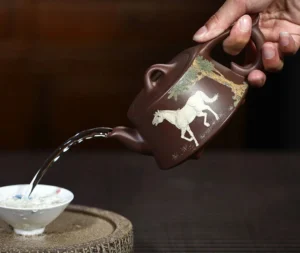
- What to do: If possible, ask to fill the pot with water. Pour it out in a steady stream. The water should come out as a smooth, cohesive “column,” not a scattered, splashing trickle. When you stop pouring and right the pot, the water should stop immediately—no “dribbling” from the spout.
- Why it matters: A clean, forceful pour gives you control over your brew and makes serving neat. Dribbling is messy and can stain your tea table.
- Beginner Tip: Don’t be shy to ask a reputable seller to demonstrate the pour. They should be confident in showing you.
5. Feel the Pot and Listen to Its Sound
Engage your sense of touch and hearing for the final check.
- What to do: Hold the empty pot. Does the handle feel comfortable in your grip? Now, take the lid and gently tap it against the body of the pot. Listen. A true Yixing clay pot will make a crisp, resonant, almost metallic “clink,” not a dull “thud.”
- Why it matters: Comfort is key for daily use. The distinctive ringing sound is due to the unique quartz content in the clay and is a classic authenticity check.
- Watch out for: A handle that feels awkward or digs into your fingers. A dull sound when tapping can indicate inferior or impure clay.
Common Mistakes When Choosing a First Yixing Pot
Chasing Rare Clay Names: Beginners often get fixated on finding “rare” clay like dicaoqing or zhuni. At the entry level, focus on finding genuine zisha* (紫泥, 朱泥, 段泥) from a trustworthy source instead of a potentially fake “rare” clay. Prioritizing “Full Hand-Made”: While beautiful, fully hand-made pots command high prices. For a first pot, a well-crafted semi-hand-made (半手工, bàn shǒugōng*) pot, where a mold assists the basic shape, offers excellent quality and value. The performance is what counts. Buying Based Only on the Artist’s Stamp: A fancy stamp (印章, yìnzhāng*) can be faked. Judge the pot by the five criteria above first. The stamp should confirm quality, not be the sole reason for it.
- Choosing a Tiny Pot Because It’s Cute: Mini pots (under 100ml) are charming but very challenging to brew with, as they cool extremely fast. For beginners, a 150-200ml pot is much more forgiving and practical.
Quick Reference: Beginner Yixing Teapot Checklist
- Clay: Earthy, natural colors with visible grain. Avoid shiny or neon-bright pots.
- Balance: Sits flat. Spout, knob, and handle are aligned.
- Lid: Turns smoothly. Blocks flow when air hole is covered.
- Pour: Clean, column-like stream. Stops instantly without dribbling.
- Sound: Clear, resonant “clink” when lid taps body.
- Size: 150-200ml is the ideal beginner-friendly capacity.
- Budget Priority: Spend on verified, genuine clay and good craftsmanship over fancy names or claims of rarity.
One Insider Tip
When you pick up a pot that feels “right,” you’ll know. But here’s what they don’t tell you: run your fingertip lightly along the inside of the spout’s opening. It should be smooth and finished. A rough, sharp, or jagged edge inside the spout is a sign of neglected detail work and can affect water flow over time. A good craftsman finishes what you can’t see.
Frequently Asked Questions
What is the best Yixing clay for a beginner?
Start with Zini (紫泥, purple clay). It’s the most common, versatile, and forgiving. It works well with most tea types, especially darker oolongs and pu-erh, and is less fragile than other clays.
How much should I spend on my first Yixing teapot?
Plan to spend between $80 and $200. This range typically gets you a pot of genuine clay with solid craftsmanship from a reputable seller. Much less, and you risk fake clay; much more, and you’re often paying for artistic value you may not yet appreciate.
Can I use one Yixing teapot for all types of tea?
Technically yes, but it’s not ideal. Yixing clay is absorbent and will retain the aroma of the tea you brew in it. For the best flavor, it’s recommended to dedicate one pot to one broad category of tea (e.g., one for roasted oolongs, one for ripe pu-erh).
How do I know if a Yixing teapot is handmade?
Look for subtle, uneven tool marks on the interior walls, slight asymmetry, and a unique, not perfectly uniform, texture. However, don’t obsess over this as a beginner. A high-quality semi-handmade pot is a perfect and more affordable starting point.
Should the teapot come with a certificate?
A certificate from a known artist can verify authenticity, but for a beginner pot, trust your direct inspection more than a piece of paper. Many excellent, non-famous crafters make wonderful pots without formal certificates. Use the 5-step guide above as your primary verification.
The right Yixing pot isn’t just a tool; it’s a collaborator that quietly improves with every cup you share. Its value isn’t locked in its price, but in the patina of your own tea rituals that will slowly bloom on its surface.
Ready for the next step? Learn how to care for your new pot and start the rewarding process of “seasoning” it in our guide: Yixing Teapot Care and Maintenance: The First 30 Days.